
Sendekem Executive Vulnerability Assessment
When an executive is harmed, the damage reaches past the family to the company’s leadership, its people, its brand, and its share price. Attacks grow out of grievance or simple opportunity, and many follow warning signs or exposure that could have been found in advance.
Protection that isn’t built on an honest assessment is guesswork. The SEVA is that assessment: an independent study of where an executive is exposed, how likely each risk is, and what a sensible response looks like. Physical attack is the risk people picture. Quieter threats, such as doxxing, impersonation, and surveillance, are often more likely, and we give them equal weight.
What the SEVA Covers
The SEVA examines the risks surrounding an executive, board member, or at-risk employee, including:
- Workplace and office security
- Existing security measures and policies
- Local and international travel
- The primary residence, assessed on site
- Online exposure: what anyone can learn from public sources
- Family and household members (research on children is limited to public sources and done only with aparent’s consent)
- Optional modules: medical readiness and aircraft privacy review

A Foundation for the Whole Program
Because the SEVA includes a physical assessment of the executive’s workplace, it often becomes the cornerstone of the overall security program, with a clear three-to-five-year plan covering people and facilities.
Commissioning a SEVA shows that leadership identified its risks before an incident, not after. Larger clients typically assess several top executives, using Residential Security Assessments to extend coverage to other executives based at the same office.

Built Across Disciplines
Executive security touches more than the security department. We work with Security, Legal, Human Resources, tax advisers, and executive leadership so the findings fit how the company actually runs. Security leaders come away with an independent document that supports their program internally.
The Sendekem Difference
- Independent
- Licensed
- Reviewed
- Candid
- Prioritized
- Discreet
- Thorough
- Board-ready


“Some executives want a visible security presence. Others want to be invisible. The SEVA starts with the facts, so the program that follows fits the person.”
We begin by identifying and prioritizing the assets and risks involved, measured against industry benchmarks, recognized standards, and the company’s own values. Then we work with stakeholders across the company to set the right level of security, and to learn which measures its culture will accept. Security only works if people understand it and follow it. We write recommendations with that in mind.
Advocacy
An independent report gives security leaders an outside voice that supports their program at the leadership table.
Practical
Recommendations are written to be understood, accepted, and followed by the people who have to live with them.
Benchmarks
Findings are measured against recognized standards and industry practice, not opinion.
Why Companies Commission a SEVA
A SEVA serves two purposes. First and most important, it identifies serious risks to an executive and family and what to do about them. Second, it is designed to serve as the independent security study described in Treasury Regulation §1.132-5(m)(2)(iv): performed by an independent security consultant and based on an objective assessment of all facts and circumstances. How a company treats employer-provided security for tax purposes is a determination for its tax advisers.
The SEVA gives leadership a sound basis for decisions about policies, procedures, technology, and staffing, whether that means strengthening what exists or building something new.
OUR PROCESS
Every SEVA follows the same disciplined sequence. We assess the risks facing the executive and family, then rank our recommendations by how likely each threat is and how much harm it could do.
Your team decides what to implement. We make sure the decision is informed.
01
Intake
We start with confidential questionnaires and interviews with the client’s security lead, the executive, a spouse or partner, and other adults in the household. They tell us the company’s duty-of-care obligations and the family’s own concerns and preferences.
Getting this right at the start means a report that fits, without rounds of revisions afterward.
02
On-site Assessment
We visit the workplace and residence in person and inspect them the way someone planning harm would.
Alongside the site visit, we research what a determined person could learn about the executive and family from public sources.
03
C-Suite Ready
Findings are written up, edited, and formatted to boardroom standard, in plain language, with the most important findings first.
Every report is independently reviewed by a second partner and approved by Sendekem’s founder, MJ Blais, a Licensed Private Investigator with more than 30 years in protection.
04
Delivery
The report goes to the client’s designated security leader. We remain available to answer questions as your team acts on it.
Reports are kept on file for seven years. We recommend reassessment every three years, or sooner after a significant change.
Independent
Sendekem does not sell protection, guarding, or monitoring, and our reports are not sales documents. Every recommendation is there because the facts call for it. That independence is what gives a SEVA its weight with boards and advisers.
Every SEVA is scoped to the executive, the family, and the company, and should be revisited as their circumstances change.
Good security lets an executive do the job, not hide from it.
Every SEVA delivers:
Program Review
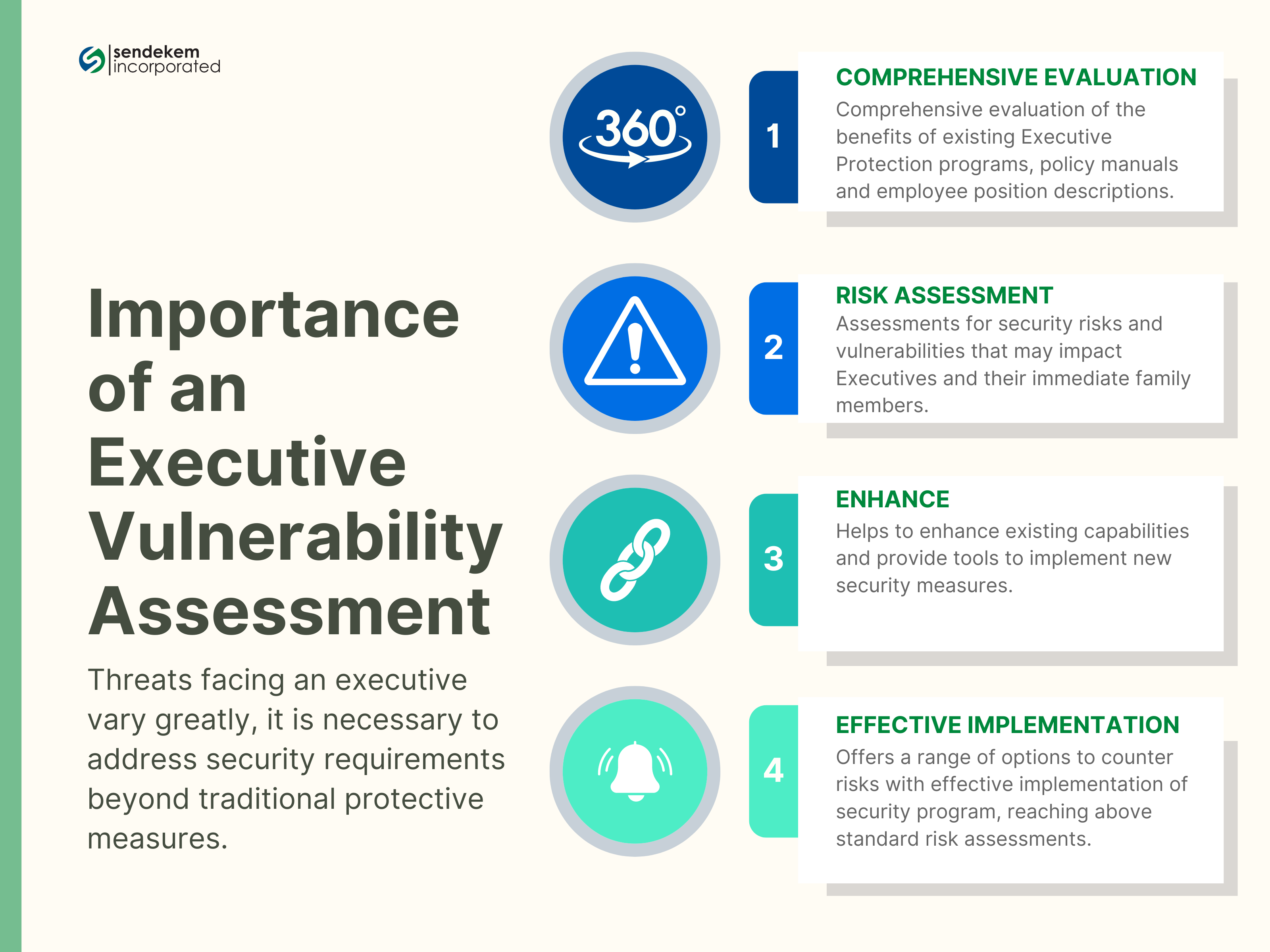
An evaluation of the executive’s existing security measures, the policies behind them, and the roles of the people responsible for them.
Home & Travel
Risk analysis of the residence, daily routines, commuting, and travel at home and abroad.
specific threats
Where a specific threat exists, an independent view of its seriousness and the measures it warrants.
priorities
Recommendations ranked by the risk they reduce for the money they cost, so leadership knows what to do first.